
Why a Crypto Bot Wins in Backtests but Loses Live
A clean backtest is comforting. It gives a strategy a number, a chart, a win rate, and the feeling that the hard part is already solved. Then the bot goes live, the first week looks different, and the trader starts asking the right question too late: why did the same rules behave so well on historical candles and so poorly with real orders? The short answer is that a backtest is an idealized model, while live trading is an operating environment. The model may be useful, but it is not the market. It usually assumes that data arrives cleanly, orders execute at the intended price, liquidity is available, fees are simple, the strategy is not tuned to noise, and the future will resemble the sample used for testing. Live trading checks every one of those assumptions at once. This article is not an argument against backtesting. Backtesting is still one of the most important filters before a crypto bot touches capital. The point is narrower and more practical: a profitable backtest is a starting hypothesis, not a deployment certificate. The goal is to understand the main reasons a bot can win in simulation and lose in production, then turn those reasons into a launch checklist.
The gap is not a mystery
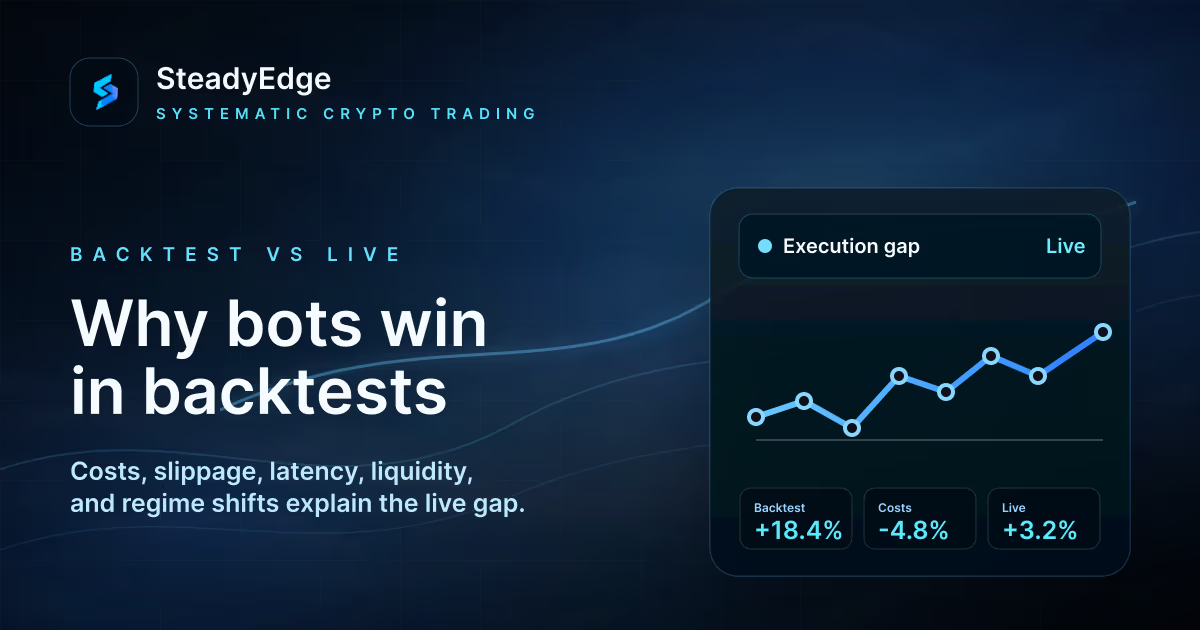
When traders say a bot “failed live,” they often imagine a hidden code defect. Sometimes that is true, but most backtest-to-live gaps are less dramatic. They come from small differences that accumulate: a taker fee here, a slightly worse fill there, a candle close that arrives one second late, a partial fill during a thin order book, a funding payment ignored by the model, or a parameter set that looked brilliant only because it was tuned to one historical period. The useful mental model is not “backtest versus live.” It is “gross signal edge minus operating costs.” Backtest PnL is often close to the gross edge. Live PnL is what remains after the strategy pays for execution, timing, liquidity, account constraints, monitoring, and regime change. If the edge per trade is small, even modest friction can erase it. If the strategy trades frequently, the same friction is paid again and again.
The backtest-to-live gap is usually a chain of small frictions, not one dramatic bug. Research on execution-constrained crypto backtesting reaches the same conclusion. The AutoQuant paper specifically studies how execution delay, funding, fees, and slippage can inflate reported performance in cryptocurrency perpetual futures. The exact numbers will differ by exchange, market, size, and strategy, but the direction is consistent: a zero-cost or fee-only backtest is usually too generous.
Costs are strategy parameters, not afterthoughts
Fees look simple until they are multiplied by turnover. A strategy that enters and exits once a month can survive a fee model that is slightly wrong. A strategy that trades several times a day cannot. Every entry, exit, scale-in, scale-out, stop, and re-entry has a cost. On futures or perpetual swaps, funding can add another layer. A backtest that ignores funding may make a carry-heavy or high-turnover system look stronger than it is. Spread matters too. If the backtest uses candle close prices, it may implicitly assume the bot can buy and sell at the same clean reference point. In live markets, buyers usually pay the ask and sellers hit the bid. That difference is tiny on the most liquid BTC pairs during calm hours, but it can widen on smaller symbols, during news, or when volatility spikes. A strategy that captures small moves is especially vulnerable because spread consumes the same small move it is trying to monetize. The first live-readiness question is therefore not “What was the return?” It is “How much return per unit of cost did the strategy generate?” If the expected trade only earns a few basis points before costs, the bot is fragile. If a doubled-fee or doubled-slippage stress test turns the equity curve from stable to broken, the strategy is not robust enough for live deployment.
Slippage and liquidity change the trade you thought you tested
Slippage is the difference between the price the strategy expected and the price it actually received. It is not always a mistake. It is what happens when an order enters a moving market. In crypto, this is intensified by twenty-four-hour trading, fragmented liquidity, sudden volatility, and symbols whose depth changes quickly. A market order in a quiet book and the same market order after a liquidation cascade are not equivalent events. Liquidity also makes position size part of the strategy. A backtest can scale a signal from 100to100 to 100to100,000 without changing the candles. The market cannot. Larger orders consume depth, wait in the book, fill partially, or push the average execution price away from the assumed entry. The result is a strategy that looked capacity-free in historical candles but becomes worse as soon as order size becomes visible to the order book. Partial fills are another source of mismatch. Backtests often assume an entry is complete or not complete. Live execution can be messier: half the position fills, price moves away, the remaining order is canceled, and the exit logic now manages a smaller or differently priced position. If the bot’s accounting, sizing, and stop logic do not handle that cleanly, the live path diverges from the tested path even if the signal rules are unchanged.
Latency moves the strategy from candle logic to execution reality
Many crypto strategies are written as if a signal and an order are one event. In production they are a sequence. Market data arrives, the candle or tick is processed, the signal is evaluated, risk checks run, the exchange request is signed, the order is submitted, the exchange accepts it, and the fill arrives later. Each step is small, but the market can move while the sequence is happening. Latency does not only matter for high-frequency trading. A four-hour strategy can still suffer when it assumes execution at the exact candle close, especially if many traders are watching the same close. A stop-loss can also behave differently live because trigger price, order type, matching engine behavior, and fast candles interact. The backtest sees one line; the exchange sees an event stream. A realistic backtest should avoid impossible execution semantics. If the signal is known only after a candle closes, the model should not enter at the same candle’s best historical price. If the strategy depends on indicators that use close values, the trade should be tested on the next executable moment. That single shift can remove a surprising amount of fake performance.
Overfitting: when the backtest learns the past too well
Overfitting is the quiet killer of bot strategies. It happens when rules are shaped around historical noise instead of repeatable behavior. The trader adds one filter, changes one threshold, excludes one bad period, shortens one moving average, and repeats the loop until the equity curve looks smooth. The backtest improves, but the strategy becomes less real. The problem is well documented beyond crypto. In the paper All that Glitters Is Not Gold , the authors studied a large set of algorithmic strategies and found that commonly reported backtest metrics such as Sharpe ratio had little predictive value for out-of-sample performance. They also found evidence that heavier backtesting effort was associated with a larger gap between backtest and out-of-sample results. That is exactly the danger retail bot builders face when they keep searching for the perfect settings.
Overfitting turns the historical sample into the strategy itself. A healthier workflow separates discovery from validation. Use one period to design the idea, another period to evaluate it, and a later walk-forward process to test whether it survives changing conditions. Do not judge a strategy only by the best optimized run. Judge it by how gracefully performance degrades when costs rise, parameters move slightly, symbols change, and market regimes shift.
Market regimes make good rules look broken
A strategy can be legitimate and still lose live because the market regime changed. Trend-following systems often look excellent during persistent moves and frustrating during choppy ranges. Mean-reversion systems can harvest small reversals until a breakout turns every dip into continuation. Grid and DCA styles can feel stable inside a range and dangerous when price leaves the range with momentum. Crypto makes this more visible because regimes can shift quickly. A pair can move from liquid and orderly to thin and violent in the same week. Correlations can rise during stress, so a portfolio that looked diversified in the backtest behaves like one large position live. Volatility filters, volume filters, funding filters, and symbol selection rules are not decorative; they define when the bot is allowed to trust its own edge. The practical question is not “Does this strategy work?” It is “Under which conditions does this strategy work, and how do we know when those conditions are absent?” A backtest should be sliced by regime: trending periods, sideways periods, high-volatility periods, low-liquidity periods, bull phases, bear phases, and quiet weekends. If all profits come from one narrow market state, the live bot needs rules for standing down outside that state.
API and account setup are part of live performance
Live trading also depends on the account boundary. API keys are operational infrastructure, not an admin detail. Binance explains that API keys should be protected carefully, not stored in plain text, rotated when needed, and restricted by IP where possible; it also describes API permission scopes and IP restrictions in its API key security guide . Bybit’s API key creation guide similarly treats key creation and permissions as a deliberate setup flow, not a copy-paste afterthought. For a trading bot, the safest default is narrow permissioning: read and trade only where needed, no withdrawal access, and keys separated by environment or account when possible. A key with the wrong permissions can block orders, fail validation, or create a security risk. A key used from the wrong IP can fail at the worst moment. A bot that cannot place or cancel orders reliably is not the same bot that passed the backtest. Monitoring belongs in the same category. A live system needs alerts for rejected orders, stale data, missed heartbeats, abnormal slippage, unexpected exposure, and drawdown limits. Without monitoring, the trader discovers operational failures only after PnL has already recorded them.
A live-readiness checklist
Before moving from backtest to live, the strategy should pass a checklist that is stricter than “the curve went up.” First, model the real fee schedule, expected spread, conservative slippage, and funding where relevant. Second, validate on data not used during design. Third, run walk-forward or rolling-window checks so the strategy proves it can adapt without being re-optimized into the past. Fourth, test sensitivity. A robust strategy should not collapse when a moving average changes from 21 to 24, when slippage doubles, or when one symbol is removed. Fifth, start live with small size. The first live deployment is not about maximizing return; it is about measuring whether fills, latency, order states, and realized costs match assumptions. Sixth, define stop conditions before launch: maximum daily loss, maximum strategy drawdown, stale data threshold, rejected order threshold, and manual review triggers.
A bot is not live-ready until the operating assumptions are explicit. The checklist should be written down because live markets create pressure. When a bot loses money, it is tempting to change settings mid-run. When a bot wins, it is tempting to increase size too quickly. A written operating plan turns those moments into decisions that were already made calmly.
Where SteadyEdge fits
SteadyEdge is built around the workflow this article describes: build the strategy, validate it historically, launch with controlled assumptions, and monitor what happens after deployment. The platform cannot make market risk disappear, and no serious tool should promise that. Its value is in making the process more explicit: strategy configuration, backtest context, live controls, analytics, and operational review belong in one loop. That loop matters because the best trading systems are not judged by one beautiful backtest. They are judged by how clearly they explain their assumptions, how quickly they expose mismatches, and how disciplined the trader is when reality disagrees with the model. A bot that loses live after a weak backtest is expected. A bot that loses live after a strong but unrealistic backtest is preventable. The difference is process.
Educational disclaimer
This article is for educational purposes only and is not financial advice, investment advice, or a recommendation to trade any asset or use any specific strategy. Crypto assets are volatile, automated trading can amplify losses, and past performance does not guarantee future results. Always test carefully, use risk limits, and make independent decisions.