
From backtest to live trading: Demo, Testnet, and Paper in SteadyEdge
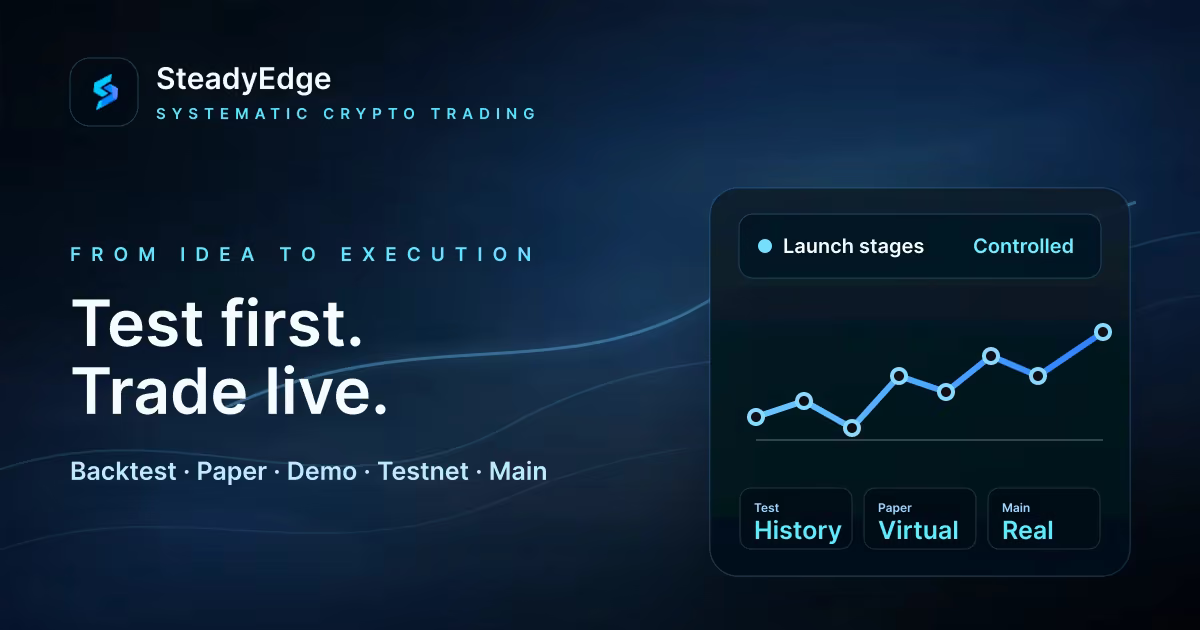
SteadyEdge provides a complete path from the first review of an idea to strategy execution on a real exchange account. You can inspect the public demo, run a backtest on real market history, start the bot in Paper trading, validate exchange integration through Demo or Testnet, and only then move to Main with real funds.
These modes do not duplicate one another. Each answers a different question: do you understand the report, does the idea survive historical testing, does the bot behave correctly on a live data stream, does the exchange accept its orders, and are you ready to cap real risk?
The modes at a glance
Stage
Market data
Where orders go
Funds
API key
Primary purpose
Public demo
A completed official backtest
Nowhere
Not used
Not required
Learn how to inspect a report before signup
Backtest
Historical mainnet candles
Nowhere
Modeled balance
Not required
Evaluate rules over a selected period
Paper trading
Current mainnet data
SteadyEdge's internal execution model
Virtual 10,000 USDT
Not required
Observe a strategy on the live market without real orders
Exchange Demo or Testnet
Data from the selected sandbox; SteadyEdge charts use mainnet history
The exchange sandbox
Exchange test balance
A dedicated environment key is required
Validate the real API path and order lifecycle
Main / live
The exchange's primary market
The real exchange
Real funds in your account
A Main trading key is required
Execute a validated strategy with capped risk
It is important to separate the SteadyEdge public demo from an exchange Demo account . The first is an open example of a completed backtest, not a trading mode. The second is a dedicated exchange environment where a bot sends test orders through the API.
Public demo: understand the product without an account or keys
At /en/demo , you can inspect a completed official backtest: test settings, equity curve, net result, maximum drawdown, fees, funding, and both winning and losing trades. You do not need a SteadyEdge account or exchange key.
The public demo helps establish what evidence you should expect from a strategy. It shows the experiment conditions and the uncomfortable parts of the result, not only the final return. It does not create a bot, submit a real queue job, or send any order.
This is a useful zero-risk starting point: learn how to read the result before building your own configuration.
Backtest: evaluate the idea on real market history
A backtest replays strategy rules over stored historical mainnet data. You define the exchange, market, pairs, timeframe, date range, starting balance, sizing, entries, exits, grid, and risk controls. Trading fees are included in the result, and futures scenarios can include funding.
The purpose is not to certify future profit. It is to reject weak hypotheses. Review maximum drawdown, trade count, losing periods, time in position, and whether a few exceptional trades explain most of the outcome. Run the test again after any material rule change.
Historical candles cannot fully reproduce order-book depth, queue position, latency, rejected orders, connection failures, or future liquidity. A credible backtest earns the strategy another limited experiment; it does not justify an immediate increase in risk.
Paper trading: live market, virtual funds
Paper trading is SteadyEdge's built-in execution mode. The bot reads current mainnet data from Binance, Bybit, OKX, or Gate and uses the same strategy and risk configuration, but it operates on a virtual account. No exchange API key is needed and no real exchange order is created.
Select Paper in the bot editor, then choose the exchange, Spot or Futures, and a trading pair. Paper is available for supported markets across all four integrations. The strategy still needs a completed backtest before launch.
The Paper account starts with 10,000 USDT . SteadyEdge maintains available and reserved balances, virtual assets, and an activity ledger. Buys are modeled from the ask and sells from the bid; adverse slippage, virtual trading fees, and futures funding are applied. Market orders fill immediately in the model, while limit orders wait for the market to cross their price.
Paper is especially useful for observing behavior over time: signal frequency, bot state transitions, notifications, exits, and risk controls. Unlike a backtest, it cannot fast-forward through months. The bot sees the market that exists now.
Paper does not validate exchange authentication and does not reproduce full order-book depth, partial fills, queue priority, or actual network latency. The next stage is designed to test the exchange API itself.
Demo and Testnet: test orders reach the exchange
Demo and Testnet are sandbox environments operated by an exchange. You create a dedicated API key there and select the matching environment and product in SteadyEdge. The bot sends orders to the exchange's sandbox APIs rather than the internal Paper model; balances and order responses also come from that environment.
This stage can verify:
- whether the key, environment, region, and Spot/Futures selection match;
- whether the key has sufficient trading permission;
- whether order quantity and precision are calculated correctly;
- whether create, cancel, and close operations succeed;
- whether statuses, errors, and notifications are handled correctly;
- whether the bot restores the expected state after a temporary failure.
Environment availability depends on the exchange:
Exchange
Main
Demo
Testnet
Paper
Markets
Binance
Yes
Yes
Yes
Yes
Spot, Futures
Bybit
Yes
Yes
Yes
Yes
Spot, Futures
OKX
Yes
Yes
—
Yes
Spot, Futures
Gate
Yes
—
Yes
Yes
Spot, Futures
Demo and Testnet are not two mandatory sequential levels. They are different sandbox names and infrastructures. Use the environment your chosen exchange supports, create the key there, and never mix it with Main credentials.
SteadyEdge charts and backtests use shared primary-market history even when a Demo or Testnet account is selected. Sandbox liquidity, prices, and fills can differ from mainnet, so a successful rehearsal validates integration mechanics more than expected profitability.
Main / live: real orders and real funds
In Main, the bot works with a real Binance, Bybit, OKX, or Gate account. SteadyEdge sends trading commands to the exchange but does not take custody of funds: capital remains in your exchange account.
The connection needs read and trading permissions only. Withdrawals, transfers, subaccount management, and administrative permissions are not required. The key must match the selected exchange, product, and Main environment.
Spot behavior is long-only. Long and Short are available where the futures or margin path supports them. Even after successful testing, start with the smallest sensible position size and leverage. Live execution introduces actual liquidity, slippage, latency, rejected orders, and operational risk.
A logical path from testing to real funds
A controlled workflow looks like this:
- Inspect the public demo. Learn to read settings, net results, drawdown, and the trade journal.
- Formalize the strategy. Write measurable entry, exit, sizing, and stop conditions.
- Run the backtest. Include fees and funding, use a meaningful period, and keep losing trades visible.
- Start Paper. Observe the same configuration on the current market without keys or real funds.
- Validate Demo or Testnet. Connect a trade-only key and confirm the full order lifecycle inside the exchange environment.
- Define promotion criteria. Set the initial risk, acceptable model divergence, daily loss limit, and exact stop condition in advance.
- Launch Main at small scale. Do not change the rules and risk size at the same time; compare live trades with the backtest, Paper, and sandbox results.
Advance only when the current stage has answered its question without unexplained failures. High backtest PnL does not replace stable Paper behavior, and a successful Testnet order does not prove that a strategy is profitable.
The main advantage of SteadyEdge is that every stage stays in one connected workflow. You do not need to rebuild the configuration in separate tools: strategy settings, tests, Paper, exchange environments, journals, metrics, and notifications remain linked.
Backtests, Paper trading, Demo, and Testnet do not guarantee future returns or reproduce every condition of live execution. Cryptoasset trading involves substantial risk.